
Calcium Carbonate Manufacturing Process: How Calcium Carbonate Is Produced
Calcium carbonate is one of the most widely used mineral compounds in industries such as plastics, paints and coatings, paper, construction, rubber, adhesives, pharmaceuticals, agriculture, and animal feed. Its versatility, availability, and cost-effectiveness make it an important raw material for manufacturers across the world.
Calcium Carbonate Manufacturing Process at a Glance
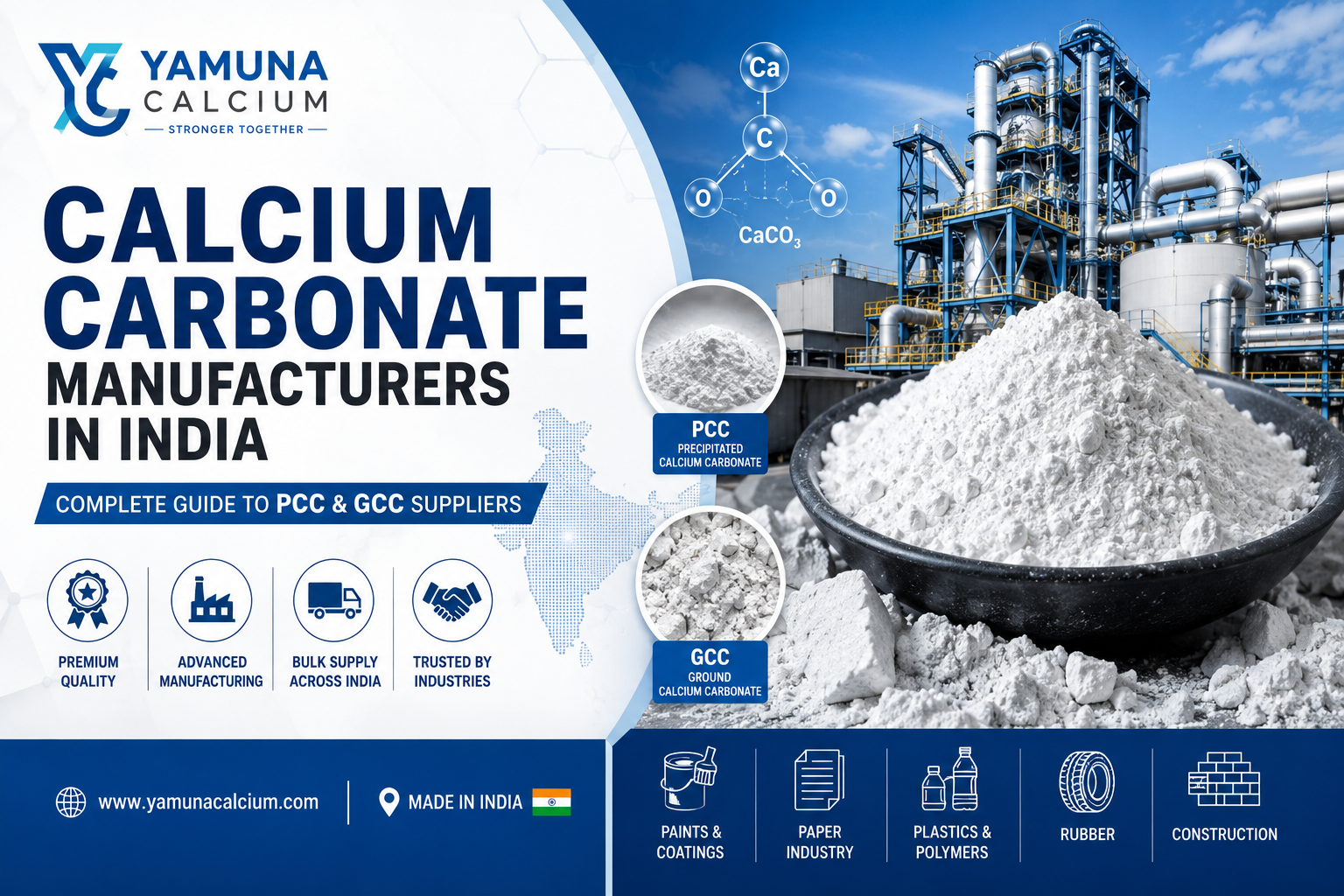
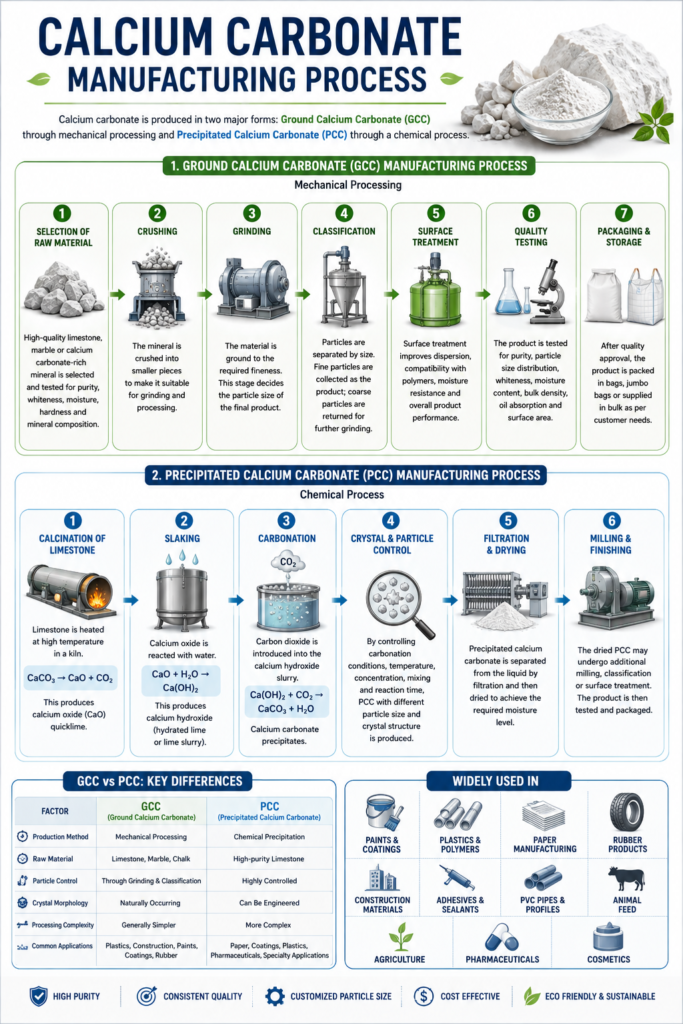
From raw material selection to grinding, classification, carbonation, quality testing, and packaging, the calcium carbonate manufacturing process varies depending on whether GCC or PCC is produced. The infographic below provides a visual overview of both manufacturing processes.
How Calcium Carbonate Is Manufactured: A Complete Guide
The calcium carbonate manufacturing process varies depending on the type and grade required. Broadly, calcium carbonate is produced in two major forms: Ground Calcium Carbonate (GCC) and Precipitated Calcium Carbonate (PCC).
GCC is produced by mechanically processing naturally occurring calcium carbonate minerals, while PCC is manufactured through a controlled chemical process.
In this guide, we explain how calcium carbonate is produced, the major manufacturing steps, the difference between GCC and PCC, and frequently asked questions about calcium carbonate production.
What Is Calcium Carbonate?
Calcium carbonate is a naturally occurring mineral with the chemical formula CaCO₃. It is primarily found in materials such as limestone, marble, and chalk.
Due to its high calcium content, brightness, particle-size flexibility, and chemical properties, calcium carbonate is used in a wide range of industrial applications.
Common applications include:
- Paints and coatings
- Plastic and polymer products
- Paper manufacturing
- Rubber products
- Construction materials
- Adhesives and sealants
- PVC pipes and profiles
- Animal feed
- Agriculture
- Pharmaceuticals
- Cosmetics
The required properties of calcium carbonate, such as particle size, whiteness, purity, surface treatment, and morphology, depend on its intended application.
Types of Calcium Carbonate
Before understanding the manufacturing process, it is important to distinguish between the two main industrial forms of calcium carbonate.
1. Ground Calcium Carbonate (GCC)
Ground Calcium Carbonate is produced from naturally occurring calcium carbonate-rich rocks such as limestone or marble.
The material is crushed, ground, classified, and sometimes surface-treated to achieve the required particle size and performance characteristics.
2. Precipitated Calcium Carbonate (PCC)
Precipitated Calcium Carbonate is manufactured through a chemical process. It is produced by converting limestone into calcium oxide and subsequently calcium hydroxide, followed by carbonation.
PCC allows manufacturers to control characteristics such as particle size, crystal structure, morphology, and purity more precisely than conventional GCC.
Calcium Carbonate Manufacturing Process
The manufacturing process depends on whether GCC or PCC is being produced.
Ground Calcium Carbonate Manufacturing Process
The basic GCC production process involves several mechanical processing stages.
STEP 1: SELECTION OF RAW MATERIAL
High-quality limestone, marble, or another calcium carbonate-rich mineral is selected as the raw material.
The material is evaluated for factors such as:
- Calcium carbonate content
- Whiteness
- Impurities
- Moisture
- Hardness
- Mineral composition
High-purity raw material is essential when producing calcium carbonate for applications that require high brightness and consistent performance.
STEP 2: CRUSHING
The selected mineral is transported to the processing facility and crushed into smaller pieces.
Crushing reduces the size of the raw material and makes it suitable for subsequent grinding and processing.
Depending on the feed size and plant design, different crushing equipment may be used.
STEP 3: GRINDING
After crushing, the material undergoes grinding.
Grinding is one of the most important stages in calcium carbonate manufacturing because it determines the particle size of the final product.
Modern grinding systems can produce calcium carbonate in different particle-size ranges depending on the application.
STEP 4: CLASSIFICATION
After grinding, the particles are classified according to their size.
Air classifiers or other separation systems can separate fine particles from coarser particles.
The finer material can be collected as the desired product, while larger particles may be returned to the grinding system for further processing.
STEP 5: SURFACE TREATMENT
For certain applications, especially plastics and polymers, calcium carbonate may undergo surface treatment.
Surface treatment can improve:
- Dispersion
- Compatibility with polymers
- Processing performance
- Moisture resistance
- Product performance
The type of surface treatment depends on the end application and formulation requirements.
STEP 6: QUALITY TESTING
The finished calcium carbonate is tested to ensure that it meets the required specifications.
Typical quality parameters may include:
- Calcium carbonate purity
- Particle size distribution
- Whiteness
- Moisture content
- Bulk density
- Oil absorption
- Surface area
Quality testing helps maintain consistency from one production batch to another.
STEP 7: PACKAGING AND STORAGE
Once the product passes quality checks, it is packed according to customer requirements.
Calcium carbonate may be supplied in bags, jumbo bags, or bulk form depending on the application and logistics requirements.
Precipitated Calcium Carbonate (PCC) Manufacturing Process
The PCC manufacturing process is different because it involves chemical reactions.
The process generally begins with high-purity limestone.
STEP 1: CALCINATION OF LIMESTONE
Limestone is heated at a high temperature in a kiln.
The reaction can be represented as:
CaCO₃ → CaO + CO₂
This produces calcium oxide (CaO), commonly known as quicklime.
STEP 2: SLAKING
The calcium oxide is then reacted with water.
CaO + H₂O → Ca(OH)₂
This produces calcium hydroxide, also known as hydrated lime or lime slurry.
STEP 3: CARBONATION
Carbon dioxide is introduced into the calcium hydroxide slurry under controlled conditions.
The reaction is:
Ca(OH)₂ + CO₂ → CaCO₃ + H₂O
Calcium carbonate precipitates during this process.
STEP 4: CRYSTAL AND PARTICLE CONTROL
One of the key advantages of PCC manufacturing is the ability to control the characteristics of the calcium carbonate particles.
By adjusting factors such as:
- Carbonation conditions
- Temperature
- Concentration
- Mixing
- Reaction time
manufacturers can produce PCC with different particle sizes and crystal structures.
STEP 5: FILTRATION AND DRYING
The precipitated calcium carbonate is separated from the liquid phase through filtration.
The material is then dried to achieve the required moisture level.
STEP 6: MILLING AND FINISHING
Depending on the required specification, the dried PCC may undergo additional processing, classification, or surface treatment.
The finished product is then tested and packaged.
GCC VS PCC: What Is the Difference?
GCC:
- Production method: Mechanical processing
- Main raw material: Limestone, marble, or chalk
- Particle control: Controlled through grinding and classification
- Crystal morphology: Naturally occurring
- Processing complexity: Generally simpler
- Common applications: Plastics, construction, paints, coatings, and rubber
PCC:
- Production method: Chemical precipitation
- Main raw material: High-purity limestone
- Particle control: Highly controlled through chemical processing
- Crystal morphology: Can be engineered
- Processing complexity: More complex
- Common applications: Paper, coatings, plastics, pharmaceuticals, and specialty applications
The choice between GCC and PCC depends on the technical requirements, application, performance expectations, and cost considerations.
Factors Affecting Calcium Carbonate Quality
Several factors influence the quality and performance of the final calcium carbonate product.
Raw Material Purity
High-quality limestone or marble with low levels of unwanted minerals can help produce calcium carbonate with better brightness and consistency.
Particle Size
Particle size has a significant impact on properties such as dispersion, opacity, surface area, and processing behavior.
Whiteness
High whiteness is particularly important in applications such as paints, coatings, plastics, and paper.
Moisture
Controlled moisture content is important for processing, storage, and application performance.
Surface Treatment
Surface-treated calcium carbonate can provide improved compatibility with specific polymers and other materials.
Production Technology
Modern grinding, classification, precipitation, drying, and quality-control technologies can improve consistency and product performance.
Applications of Manufactured Calcium Carbonate
Calcium carbonate is used across numerous industries.
Plastics
Calcium carbonate can be used as a functional filler in products such as pipes, profiles, films, sheets, and injection-molded components.
Paints and Coatings
Calcium carbonate can contribute to opacity, brightness, rheology, and cost optimization.
Paper
Both GCC and PCC are used in paper manufacturing to improve properties such as brightness, opacity, and printability.
Rubber
Calcium carbonate is used as a filler in various rubber products.
Construction
Calcium carbonate is used in selected construction materials and formulations, including certain sealants, adhesives, and building products.
Agriculture
Calcium carbonate can be used as a calcium source and for soil applications where appropriate.
Animal Feed
Feed-grade calcium carbonate can serve as a calcium source when manufactured and supplied according to applicable feed-quality requirements.
Why Is Quality Control Important in Calcium Carbonate Manufacturing?
Consistent quality is essential because different industries require different calcium carbonate specifications.
A reliable manufacturing process should monitor raw materials, particle size, chemical composition, moisture, whiteness, and other relevant characteristics.
For industrial buyers, consistency from batch to batch can be just as important as the quality offered by a calcium carbonate manufacturer.
Frequently Asked Questions About Calcium Carbonate Manufacturing
1. HOW IS CALCIUM CARBONATE PRODUCED?
Calcium carbonate is produced mainly through two methods. GCC is manufactured by crushing, grinding, classifying, and sometimes surface-treating naturally occurring calcium carbonate minerals. PCC is produced chemically by calcining limestone, slaking the resulting calcium oxide, and carbonating calcium hydroxide.
2. WHAT IS THE RAW MATERIAL USED TO MAKE CALCIUM CARBONATE?
Limestone, marble, and chalk are common natural sources of calcium carbonate. High-purity limestone is commonly used when producing PCC.
3. WHAT IS THE CHEMICAL FORMULA OF CALCIUM CARBONATE?
The chemical formula of calcium carbonate is CaCO₃.
4. WHAT IS THE DIFFERENCE BETWEEN GCC AND PCC?
GCC is obtained through mechanical processing of natural calcium carbonate minerals, whereas PCC is produced through a controlled chemical precipitation process.
5. WHICH IS BETTER: GCC OR PCC?
Neither is universally better. The appropriate choice depends on the application. GCC may be preferred for applications where cost-effectiveness and natural mineral processing are important, while PCC offers greater control over particle characteristics and morphology.
6. HOW IS GCC MANUFACTURED?
GCC is generally manufactured by selecting suitable limestone or marble, crushing it, grinding it to the required fineness, classifying the particles, and optionally applying surface treatment.
7. HOW IS PCC MANUFACTURED?
PCC is generally manufactured through the following steps:
Calcination → Slaking → Carbonation → Filtration → Drying → Finishing
8. WHY IS LIMESTONE HEATED DURING PCC PRODUCTION?
Heating limestone decomposes calcium carbonate into calcium oxide and carbon dioxide. The calcium oxide is then used in subsequent steps to produce precipitated calcium carbonate.
9. WHAT DETERMINES THE QUALITY OF CALCIUM CARBONATE?
Important factors include raw material purity, calcium carbonate content, particle size distribution, whiteness, moisture, surface area, crystal structure, and surface treatment, depending on the intended application.
10. WHAT INDUSTRIES USE CALCIUM CARBONATE?
Calcium carbonate is widely used in plastics, paints, coatings, paper, rubber, construction, adhesives, agriculture, animal feed, pharmaceuticals, and other industries.
11. CAN CALCIUM CARBONATE BE SURFACE TREATED?
Yes. Calcium carbonate can be surface-treated to improve its compatibility, dispersion, and performance in specific applications, particularly in polymers and plastics.
12. IS CALCIUM CARBONATE NATURALLY OCCURRING?
Yes. Calcium carbonate occurs naturally in minerals such as limestone, marble, and chalk, as well as in biological materials such as shells.
Conclusion
The calcium carbonate manufacturing process depends largely on the type of product being produced. Ground Calcium Carbonate is manufactured through mechanical processing, including crushing, grinding, classification, and optional surface treatment, while Precipitated Calcium Carbonate is produced through a controlled chemical process involving calcination, slaking, and carbonation.
Understanding these manufacturing methods helps industrial buyers select the right calcium carbonate grade for their specific application. Purity, particle size, whiteness, morphology, moisture, and surface treatment are among the key factors that determine product performance.
For manufacturers and industrial users, choosing a calcium carbonate manufacturer with consistent quality, reliable production capabilities, and appropriate technical specifications is essential for achieving dependable results.